Resources:
Daily Telegraph on cooling rack mount servers in offices
CIO Magazine on IBM's new cooling technologies for servers
Suppliers:
Dell
Cisco
HP
Intel
Sun Microsystems
Supermicro
Hitachi
If your business requires a highly efficient use of existing floor space and
other IT resources without the technology curve involved with blades, you should
consider a rack system....
HP's
guide to server format selection
Built into a cabinet that has a standard width of 19" or 24". All types of
electronics and computing devices come in rack-mounted packages....
YourDictionary.com illustrates rack mount servers
Rack Mounted ServersDefinition: A rack mount server is a computer built into a special case, instead of a standalone case like a desktop or tower case, that can be slotted into an industry standard 19-inch equipment rack.
For servers to use this rack format they need to be in cases that will fit the standard dimensions. The cases need to have mounting brackets at the front (sometimes at the back too) with holes drilled in the correct places to match up with the holes on the posts. Rack Mount Servers in Business Environments
Once a company begins to grow to the point where they have a few small servers dotted around the offices, with fans on permanently next to people trying to work and make phone calls, a rack mount cabinet can be just the right move. Racks of all shapes and sizes nearly always come with removable doors and side panels. A closed cabinet can be best for an office environment because as well as keeping the noise in, the computing and network equipment can be locked, securing it from tampering, either deliberate or accidental. Server Configuration for Rack Mounting The server components that go into rack mount cases are not a great deal different from those that would be found in a tower or desktop case. A server should be specified according to the work that it needs to do rather than the format of the case it is going to be put in. Many major computer suppliers provide servers in rack mount format or they can be built into a case for bespoke needs. The real difference when it comes to specifying components is that the space constraints of a rack mount case need to be taken into account.
Dealing With Smaller Rack Heights
The width and height of a rack mount server case are the critical dimensions; depth is to some extent less important. There are many rack depths available but servers are usually mounted on drawer-style rails so that they can be slid out for easy maintenance. This also means that only one person needs to be there. If a server is bolted directly to the rack posts at the back and the front then a second person is vital when removing or installing a server to avoid it being dropped. Precautions when Moving to Rack Mount Servers If you are considering moving to a rack mount server environment, perhaps to house a growing collection of equipment in a closed cabinet, there are three things that need to be considered as well as those we have already talked about. The first is to assess the power requirements and make sure that you have an adequate supply. You should also consider having a backup power source and a backup of critical data to another location as your data and computing facilities are now all going to be in one place. Finally make sure that you have adequate cooling for all the equipment. Rack mounted fans are available to draw cooling air through a cabinet but air conditioning might be necessary. |
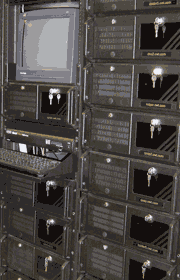
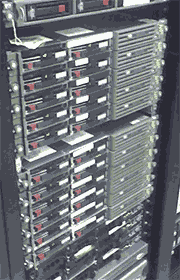 When
talking about rack mount servers most people have a vision of a huge
computer room with mile upon mile of computing equipment of all sorts.
This of course is where most rack mount servers are to be found but small
and medium-sized businesses can also make use of them. It's not only seven
foot tall racks that use the rack mount format. There are many other
smaller cabinets, floor mounted or wall mounted, that can take a couple of
servers, a network switch, access point and a cabling patch panel as well,
centralising all the computing equipment in one place.
When
talking about rack mount servers most people have a vision of a huge
computer room with mile upon mile of computing equipment of all sorts.
This of course is where most rack mount servers are to be found but small
and medium-sized businesses can also make use of them. It's not only seven
foot tall racks that use the rack mount format. There are many other
smaller cabinets, floor mounted or wall mounted, that can take a couple of
servers, a network switch, access point and a cabling patch panel as well,
centralising all the computing equipment in one place. 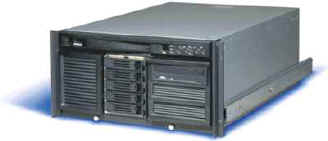 Servers are available in many different heights and
the lower the height the more computing you can fit into the available
space. But this also means that the cost of each server goes up as you
will need specialist components to fit in the available space. The
standard unit of measurement for rack height is a rack unit, normally
referred to as a 'U', which equates to just under 1.75 inches, the height
that covers three rack post holes. So a 5U server, which used to be the
default size, would be
Servers are available in many different heights and
the lower the height the more computing you can fit into the available
space. But this also means that the cost of each server goes up as you
will need specialist components to fit in the available space. The
standard unit of measurement for rack height is a rack unit, normally
referred to as a 'U', which equates to just under 1.75 inches, the height
that covers three rack post holes. So a 5U server, which used to be the
default size, would be
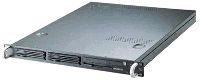 just under 8.75 inches, more than enough to
accommodate a normal PC motherboard along with a complete collection of
expansion slots and cards and a number of disk drives and optical drives.
The measurements are always around 1/32nd of an inch less than
the full 'U' height to allow room to manoeuvre equipment in and out of the
racks.
just under 8.75 inches, more than enough to
accommodate a normal PC motherboard along with a complete collection of
expansion slots and cards and a number of disk drives and optical drives.
The measurements are always around 1/32nd of an inch less than
the full 'U' height to allow room to manoeuvre equipment in and out of the
racks.  Increasingly
servers have become smaller and now 1U servers are commonplace. With 1U
servers the motherboards are customised, having the expansion slots raised
and pivoted ninety degrees so that expansion boards can run parallel to
the motherboard. It is also not unusual for the voltages delivered around
the boards to be lower than usual, around 3.3v rather than 5V. This is
because lower voltages mean less power consumed and thus less heat being
produced in a confined space. Alternatively servers have all the usual
components mounted on the motherboard to make expansion cards unnecessary.
Take care when ordering expansion boards and other accessories that they
are for the correct voltage and will fit in the case. Many expansion
boards come in half height formats to help them fit into smaller cases.
Also the hard disk space will be in a separate case, accessed over the
Increasingly
servers have become smaller and now 1U servers are commonplace. With 1U
servers the motherboards are customised, having the expansion slots raised
and pivoted ninety degrees so that expansion boards can run parallel to
the motherboard. It is also not unusual for the voltages delivered around
the boards to be lower than usual, around 3.3v rather than 5V. This is
because lower voltages mean less power consumed and thus less heat being
produced in a confined space. Alternatively servers have all the usual
components mounted on the motherboard to make expansion cards unnecessary.
Take care when ordering expansion boards and other accessories that they
are for the correct voltage and will fit in the case. Many expansion
boards come in half height formats to help them fit into smaller cases.
Also the hard disk space will be in a separate case, accessed over the