At the very simplest level, RAID combines multiple hard drives into a single logical unit.
Instead of seeing several hard drives, the OS sees only one.
RAID is typically used on server computers, and is usually done
with identically sized disk drives. With decreases in hard drive prices and wider
availability of RAID options built into motherboard chipsets, RAID is also being found and
offered as an option in more advanced personal computers. This is especially true in video and
audio editing systems. More
Short for Redundant Array of Independent (or Inexpensive) Disks, a category
of disk drives that employ two or more drives in combination for fault tolerance
and performance. RAID disk drives are used frequently on servers but aren't generally
necessary for personal computers.
More
RAID under Linux
RAID
under Apple
RAID under Windows
What is RAID, RAID explained?Definition: RAID stands for Redundant Array of Independent (or Inexpensive) Disks. It involves the
configuration (setting up) of two or more drives in combination for fault tolerance and performance.
RAID disk drives are used frequently on servers and are increasingly being found in home and
office personal computers.
|
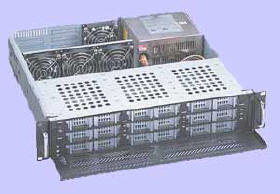 The exact meaning of RAID has been much debated and much argued. The use of "Redundant" is,
in itself, a contentious point. That several manufacturers have deviated from accepted RAID
terminology, created new levels of disk arrangements, called them RAID, and christened them
with a number has not helped. There are even some single disk RAID configurations! Double
parity, RAID 1.5, Matrix RAID etc., are examples of proprietary RAID configurations.
The exact meaning of RAID has been much debated and much argued. The use of "Redundant" is,
in itself, a contentious point. That several manufacturers have deviated from accepted RAID
terminology, created new levels of disk arrangements, called them RAID, and christened them
with a number has not helped. There are even some single disk RAID configurations! Double
parity, RAID 1.5, Matrix RAID etc., are examples of proprietary RAID configurations.